
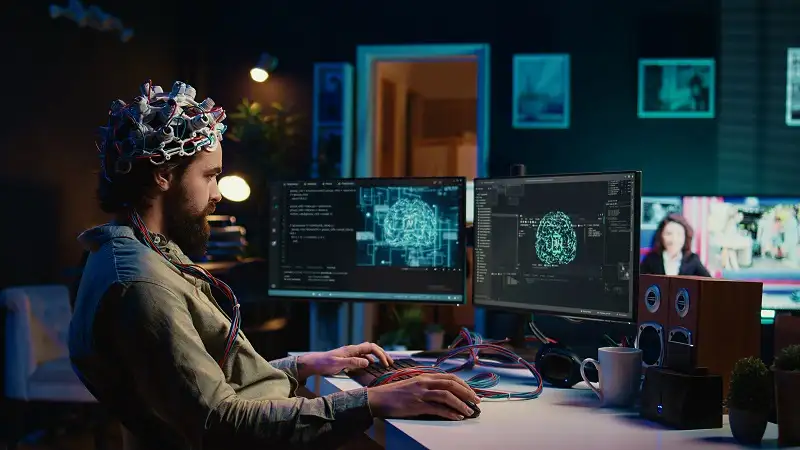
The integration of AI and Machine Learning in Game Development has fundamentally transformed how we design, build, and experience interactive entertainment. We are no longer limited to static scripts and predictable character behavior. Instead, we now develop intelligent systems capable of learning, adapting, and evolving in real time.
In modern game design, artificial intelligence is not simply about non-playable characters (NPCs) following prewritten paths. It is about creating dynamic ecosystems where characters respond intelligently to player actions. Machine learning further enhances this by enabling systems to analyze patterns, improve strategies, and personalize gameplay experiences.
We leverage advanced algorithms to simulate lifelike reactions, adaptive difficulty levels, procedural content generation, and even player behavior prediction. This shift marks a new era in immersive gaming, where intelligence is embedded directly into the gameplay architecture.
Core Technologies Powering Intelligent Game Systems
Neural Networks and Deep Learning
We implement neural networks to mimic human-like decision-making processes. These networks process vast amounts of gameplay data to train NPCs and game systems to behave more naturally. Deep learning allows characters to interpret player movements, predict outcomes, and make strategic decisions autonomously.
Through multi-layered network architectures, we enable:
- Complex enemy combat strategies
- Real-time pattern recognition
- Player style adaptation
- Intelligent resource management
Reinforcement Learning in Gameplay
Reinforcement learning enables game agents to learn through trial and error. Instead of relying on pre-coded instructions, AI agents receive rewards or penalties based on their actions. Over time, this allows them to optimize strategies.
We use reinforcement learning to create:
- Self-improving opponents
- Adaptive level progression
- Dynamic combat systems
- Evolving strategic simulations
This results in gameplay that feels organic rather than scripted.
Natural Language Processing (NLP)
With NLP integration, we allow players to interact with characters through more realistic dialogue systems. AI-driven dialogue engines analyze context, sentiment, and intent to generate meaningful responses.
This enhances:
- Interactive storytelling
- Player-driven narratives
- Dynamic quest generation
- Emotional immersion
Procedural Content Generation and Infinite Worlds
One of the most revolutionary impacts of AI and Machine Learning in Game Development lies in procedural content generation (PCG). We use machine learning algorithms to automatically generate levels, maps, characters, and quests.
Instead of manually designing every environment, we train models to understand aesthetic patterns and gameplay balance. The result is:
- Infinite replayability
- Unique player experiences
- Reduced development time
- Massive open-world scalability
AI-driven PCG ensures no two playthroughs are identical. Worlds evolve organically, offering new surprises with every session.
Adaptive Difficulty and Personalized Gameplay
Traditional games operate on fixed difficulty levels. However, modern AI systems analyze player performance in real time and adjust challenges accordingly.
We implement machine learning models that monitor:
- Reaction time
- Combat efficiency
- Resource management
- Decision-making patterns
Based on this data, the game dynamically modifies enemy intelligence, puzzle complexity, and mission structure. This ensures optimal engagement — not too easy, not overwhelmingly difficult.
Personalization increases player retention, satisfaction, and immersion.
Intelligent NPC Behavior and Realistic Interactions
NPC intelligence has advanced significantly through machine learning applications. Instead of following repetitive patterns, characters now demonstrate:
- Context-aware movement
- Emotional response simulation
- Collaborative tactics
- Strategic retreats and ambushes
We train AI models using gameplay simulations so NPCs learn advanced behaviors organically. This makes encounters unpredictable and realistic.
Enemy squads coordinate attacks. Civilians react to environmental threats. Companions adapt to player combat styles. These systems collectively elevate immersion to unprecedented levels.
AI-Driven Game Testing and Quality Assurance
Quality assurance traditionally required extensive human testing. Now, we deploy AI bots to simulate thousands of gameplay hours within minutes.
Machine learning testing systems identify:
- Exploitable mechanics
- Balance issues
- Performance bottlenecks
- Logical inconsistencies
Automated AI testing reduces development costs and accelerates production cycles. More importantly, it ensures a polished final product with minimal critical errors.
Real-Time Analytics and Player Behavior Modeling
Game development has shifted toward data-driven design. We analyze player behavior patterns using machine learning algorithms to optimize game mechanics.
We track:
- Session duration
- Decision pathways
- Engagement peaks
- Drop-off points
By studying this data, we refine level structures, reward systems, and progression curves. Behavioral prediction models allow us to anticipate churn and adjust content strategies proactively.
The result is smarter design backed by real-world performance insights.
AI in Graphics Enhancement and Animation
Artificial intelligence also enhances the visual dimension of games. Machine learning algorithms improve rendering quality, optimize textures, and generate realistic animations.
Key applications include:
- AI-assisted motion capture
- Procedural animation blending
- Real-time ray tracing optimization
- Upscaling low-resolution assets
AI-powered animation systems generate fluid, context-sensitive movements without requiring exhaustive manual keyframing. This significantly reduces production time while increasing visual realism.
Ethical Considerations and Responsible AI Implementation
As we integrate AI and Machine Learning in Game Development, ethical considerations become essential. Intelligent systems must prioritize fairness, transparency, and user safety.
We ensure:
- Data privacy compliance
- Non-discriminatory AI behaviors
- Balanced reward mechanics
- Avoidance of manipulative engagement loops
Responsible AI implementation builds player trust and maintains industry credibility.
The Future of AI and Machine Learning in Game Development
The future promises even deeper AI integration. We anticipate advancements such as:
- Fully autonomous narrative engines
- Emotionally responsive characters
- AI-generated cinematic sequences
- Cross-platform intelligent ecosystems
Generative AI will enable real-time storytelling where narratives evolve dynamically based on player emotion and intent. Game worlds will become living environments capable of continuous evolution.
Machine learning models will eventually create self-sustaining virtual universes where ecosystems develop without constant human intervention.
Competitive Advantages of AI Integration
Studios that strategically implement AI technologies gain significant advantages:
- Faster production cycles
- Reduced development costs
- Higher player retention rates
- Enhanced immersive realism
- Continuous post-launch optimization
AI-driven tools empower smaller teams to compete with large-scale studios by automating complex design tasks.
Implementation Strategy for Developers
To effectively integrate AI systems, we follow a structured strategy:
- Define gameplay objectives clearly
- Identify areas suitable for automation or intelligence enhancement
- Select appropriate machine learning models
- Train models using high-quality gameplay data
- Continuously evaluate performance metrics
Successful AI integration requires collaboration between developers, data scientists, and designers. Strategic deployment ensures optimal performance without overwhelming system resources.
Conclusion: Transforming Interactive Entertainment
AI and Machine Learning in Game Development represent more than technological trends. They redefine how we conceptualize interactivity, immersion, and storytelling.
We are building adaptive systems that respond intelligently to players. We are creating infinite worlds powered by algorithms. We are designing characters that learn, evolve, and strategize independently.
This transformation elevates gaming from scripted entertainment to dynamic simulation. The industry stands at the threshold of an intelligent revolution — and AI is the driving force behind it.